Why learn Spanish? There is no doubt that learning another language has many benefits in every way. However, why Spanish and not another one?
Clearly, it is a personal decision and it depends on many things. However, here is a list of 10 reasons to learn Spanish that I think you should consider.
Let’s get started!
It is one of the most widely spoken languages in the world.
According to data from the Cervantes Institute, in 2020 there were more than 489 million people who speak Spanish as their mother tongue, which represents 6.3% of the world’s population. Incredible, isn’t it?
And that’s taking into account only native speakers, because in reality more than 585 million people speak Spanish in total, including native speakers, limited proficiency speakers and students of Spanish as a foreign language (7.5% of the world’s population).
Thus, Spanish is the second mother tongue in the world by number of speakers, behind Mandarin Chinese, and the third language by number of speakers (native proficiency + limited proficiency + learners of Spanish), after English and Mandarin Chinese.
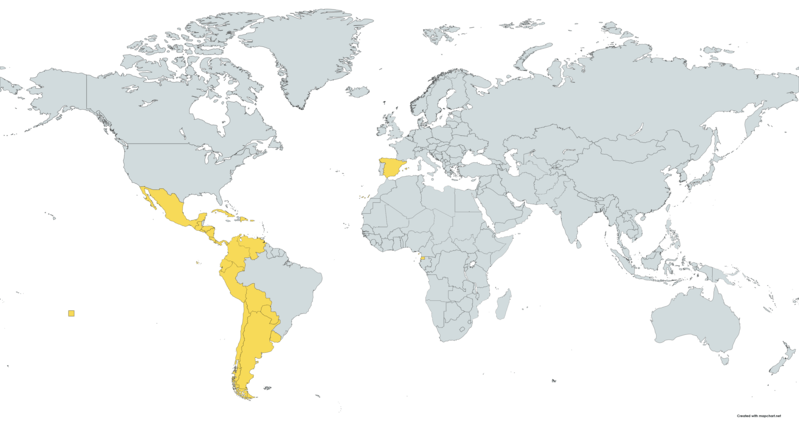
In addition, Spanish is the official language in 21 countries: Argentina, Bolivia, Chile, Colombia, Costa Rica, Cuba, Dominican Republic, Ecuador, El Salvador, Equatorial Guinea, Guatemala, Honduras, Mexico, Nicaragua, Panama, Spain, Uruguay, Peru, Puerto Rico, Uruguay and Venezuela.
It is a language with a bright future
Did you know that Spanish speakers have increased by 30% in the last decade, and foreign students by 60%? And everything indicates that the number of Spanish speakers will continue to grow over the next five decades.
Learning Spanish to study abroad
Can you imagine studying in countries with a great culture and gastronomy, such as Spain and Latin American countries?
Yes, if you know Spanish you will be able to study in these countries more easily, since in many universities and other training centers it is necessary to have a certain level of the language to be able to study in them.

Even if it is not mandatory, having knowledge of Spanish will help you a lot when it comes to making friends, shopping, going to restaurants and, in short, making the most of your adventure in the Spanish-speaking country of your choice.
Better job opportunities
In an increasingly globalized economy, being able to communicate and do business in another language is a very interesting skill for both companies and employees, and Spanish is one of the best languages for that.
In fact, according to the Cervantes Institute, the Spanish-speaking community has a purchasing power of approximately 9% of the world’s GDP, and countries with Spanish as an official language alone generate almost 7% of the world’s GDP.
And another surprising fact: if the Hispanic community in the United States were an independent country, its economy would be the eighth largest in the world, ahead of Spain’s!
Translated with www.DeepL.com/Translator (free version)

On the other hand, almost half of the products that Spanish-speaking countries import come from countries where English or Chinese is spoken.
As we have seen, Spanish speakers are a great demographic that companies should take advantage of and, for this reason, speaking Spanish will open many doors when it comes to finding work and increasing your income.
Travelling
Do you like to travel? If so, you already have a good excuse to learn Spanish. As I mentioned before, there are a total of 21 countries where Spanish is spoken as an official language, and these include such popular destinations as Spain, Mexico, Cuba, Colombia, Argentina, Costa Rica, Peru…

Visiting any of these countries without knowing Spanish can be a fantastic and enjoyable experience. Many tourists do it every year and the locals are more than used to it.
However, if you don’t speak the language you will have to visit the most touristic areas which usually do not show 100% of the culture of the country and its people.
Therefore, if you want to enjoy your stay in any of these countries much more and not miss anything, I recommend you to travel knowing at least a little bit of Spanish.
Locals appreciate it when a foreigner communicates (or at least tries to) in Spanish, as it is a sign of respect for our country, our language and our culture.
In fact, there is a quote from Nelson Mandela that I love and couldn’t agree with more:
If you talk to a man in a language he understands, that goes to his head. If you talk to him in his own language, that goes to his heart.” – Nelson Mandela
Make new friends
Learning a new language opens up a new world of people you can meet and with whom you would not have been able to communicate otherwise.
As we have seen before, Spanish has millions of speakers, so speaking it is an excellent opportunity to meet people, make friends from different parts of the world and get to know their cultures.
In addition, people from Spanish-speaking countries are quite sociable and have a great sense of humor, and will probably be happy to help you with your Spanish.

Culture and gastronomy
Studying a language is not only about learning words and grammar rules. It also means understanding the language but also the culture of the countries where it is spoken.
Fortunately, most of the countries where Spanish is spoken have a very diverse culture, full of traditions and celebrations.
Knowing Spanish immerses you in the culture of the people who speak it, brings you closer to them and allows you to understand them better.
Another very important aspect is the food, and as with the culture, each country has different types of food known worldwide.
Who does not know the famous “tapas” from Spain, the “tacos” from Mexico, the “empanadas” from Argentina, the “arepas” from Venezuela?

In fact, I like to joke about this and I always say that one of my favorite ways to study a language is through my stomach (I love to eat!) .
It is an easy language to learn
Spanish is a relatively easy language to learn if you already speak any other language derived from Latin, such as Portuguese, French, Italian, Romanian, etc.
This is because all these languages have a lot in common in terms of vocabulary and grammatical structures, so understanding and studying Spanish will be easier.
Even if you speak English, Spanish is much easier to learn compared to other languages, since you don’t need to study a new alphabet, and they also have many words in common.
But beware! Beware of what are known as false friends, those words that are the same or very similar in different languages but have a totally different meaning.
Another advantage is that Spanish is quite easy to pronounce because it is a phonetic language, that is, it is read as it is written.
In addition, it has only 24 sounds: 5 vowels and 19 consonants.

It will help you learn other languages
As we have mentioned before, Spanish is a Romance language, as are many other languages.
For this reason, if after learning Spanish you want to study another language derived from Latin, you will already know the grammatical structure of the Romance languages. Even many words will be similar, so it will take you less time to learn it.
In addition, knowing Spanish is a great advantage if you want to learn other languages that may not be so popular, since having so many speakers, you will be able to find explanations to learn those languages that you might not find in your mother tongue.
Or even find a teacher of that language and use Spanish in class. In fact, an Irish guy I know does exactly that: he learns Japanese with a native teacher who lives in Mexico because he knows Spanish and it’s the only language they have in common.
Impressive, isn’t it?
A wide range of art and entertainment
Spain and Latin American countries are countries with many artists. Knowing Spanish will give you access to endless books, movies, series, songs and much more to enjoy while improving your level in the language.
La Casa de Papel, Las Chicas del Cable, Élite or Vis a Vis are just some of the most successful Spanish series on Netflix, but there are many more with different variants of Spanish.

And let’s be honest: although many are dubbed or you could watch them with subtitles, it’s not the same as watching them in their original version.
These are the 10 reasons to learn Spanish. These are just a few reasons but it is clear that each person has his or her own and these can vary a lot between different students.
And you, why do you learn Spanish? What do you think is the most important reason?
Tell me in the comments!