Have you ever started learning Spanish and wondered if you will ever feel comfortable speaking it? Maybe you have looked at verb tables, listened to native speakers talking quickly, or tried to understand a Spanish conversation and thought, “This is going to take a long time.”
If you have asked yourself “is Spanish hard to learn?”, you are definitely not alone. This is one of the first questions many students ask me when they begin their Spanish lessons.
The honest answer is that Spanish has some challenging parts, but it is also a very rewarding language to learn. Millions of people around the world learn Spanish every year, and with the right method, regular practice, and a little patience, it is a language that you can enjoy and use in real life.
How hard is it to learn Spanish? Well, it depends on your starting point
When students ask me if Spanish is hard to learn, they often expect a simple answer. They want to know if Spanish is an easy language or a difficult one.
But languages do not work that way. The difficulty of learning Spanish depends on several things, especially your previous experience, your goals, and how you study.
One important factor is your native language. If your language shares similarities with Spanish, some parts may feel more familiar. For example, speakers of Italian, Portuguese, or French often recognize many words because these languages have common Latin roots.
On the other hand, students whose first language has a very different structure may need more time to get used to Spanish grammar or sentence patterns.
However, they often develop strong learning skills because they are already used to approaching a completely different language system.
Your experience learning other languages also matters. Someone who has already learned one or two foreign languages usually knows that progress takes time. They understand that making mistakes is part of the process.
Your goals also influence how difficult Spanish feels. Learning enough Spanish to order food, travel, and have simple conversations is very different from reaching an advanced level where you can discuss complex topics.
Finally, your learning method makes a huge difference. A student who only memorizes vocabulary lists may feel that Spanish is difficult and disconnected. A student who practises listening, speaking, and real conversations will usually progress with much more confidence.
What makes Spanish easier than many learners expect?
Although Spanish has its challenges, there are many reasons why students find it enjoyable and accessible.
Spanish pronunciation is more predictable than you think
One of the positive aspects of Spanish is that pronunciation is quite consistent. In many cases, you can read a Spanish word and have a good idea of how it sounds.
Of course, pronunciation still requires practice. Many students need time to master sounds like the Spanish r and rr, or to get used to the rhythm of natural Spanish.
Listening can also be challenging because native speakers often connect words together and speak much faster than the examples you hear in beginner materials.
However, once your ear becomes familiar with these sounds, Spanish pronunciation becomes much more predictable.
Spanish vocabulary can feel familiar
Many learners are surprised by how many Spanish words they can recognize. Depending on your native language, you may already know many words without realizing it.
Let’s see some words which are similar in Spanish and other languages:
- “hospital” (hospital).
- “animal” (animal).
- “cultura” (culture).
- “problema” (problem).
These connections can help you build vocabulary faster.
You can communicate in Spanish from the beginning
One of the biggest mistakes I see students make is waiting too long before speaking.
Many people think they need to know all the grammar first. They spend months studying but avoid real conversations because they are afraid of making mistakes.
The reality is that you can communicate with very simple Spanish.
For example:
- “Me llamo Ana” (My name is Ana).
- “Soy de Alemania” (I am from Germany).
- “Estoy aprendiendo español” (I am learning Spanish).
- “¿Puedes repetir, por favor?” (Can you repeat, please?).
These simple phrases are already useful. They allow you to connect with people, and connection is the real purpose of learning a language.
What are the hardest parts of learning Spanish?
When people ask me if the Spanish language is difficult to learn, they usually imagine grammar as the biggest obstacle. Grammar is certainly an important part of Spanish, but it is not impossible. It simply requires time and practice.
Let’s look at the areas that students usually find more challenging.
Spanish verb conjugations
Spanish verbs are one of the first things that surprise new learners.
In English and many other languages, verbs change less. In Spanish, the verb ending often changes depending on who is speaking.
For example:
- “Yo hablo español” (I speak Spanish).
- “Tú hablas español” (You speak Spanish).
- “Ellos hablan español” (They speak Spanish).
At first, this can feel like a lot of information. Students often think they need to memorize hundreds of forms immediately.
But Spanish verbs follow patterns. Once you understand the most common structures and start seeing them in real conversations, they become much easier.
Spanish gender and articles
Another common challenge is grammatical gender. In Spanish, nouns are usually masculine or feminine, and this affects the article you use.
For example:
- “el libro” (the book).
- “la mesa” (the table).
Students often ask me why a particular word is masculine or feminine. Sometimes there is a clear explanation, but sometimes you simply need to learn the word together with its article.
Instead of learning “mesa”, learn “la mesa”. This small habit will help you remember naturally.
Spanish past tenses
The past is another area where many students need time. Spanish has different ways to talk about past actions, and choosing the correct tense can feel confusing.
Compare:
- “Comí en Madrid” (I ate in Madrid).
- “He comido en Madrid” (I have eaten in Madrid).
- “Comía en Madrid” (I used to eat in Madrid).
The difference becomes clearer with examples and practice. It is not something you need to understand perfectly on your first day.
The Spanish subjunctive
The subjunctive often has a reputation for being one of the hardest parts of Spanish.
Many students hear words like “subjunctive” and immediately feel nervous. But in reality, you probably already use similar ideas in your own language.
The subjunctive is often used when talking about wishes, possibilities, doubts, or emotions.
For example:
- “Espero que tengas un buen día” (I hope you have a good day).
- “Es posible que llegue tarde a la reunión.” (It is possible that I arrive late to the meeting.)
- “No creo que ella sepa la respuesta.” (I don’t think she knows the answer.)
- “Me alegra que estés aquí conmigo.” (I’m happy that you are here with me.)
- “Quiero que estudies más para el examen.” (I want you to study more for the exam.)
The key is learning it through real expressions, not only through grammar explanations.
How hard is learning Spanish compared with other languages?
Comparing languages is complicated because difficulty depends greatly on the languages you already speak.
Spanish may feel easier than some languages because it uses the Latin alphabet, has relatively consistent pronunciation, and shares vocabulary with many other languages.
For many learners, languages such as Japanese, Mandarin Chinese, or Arabic may present additional challenges because of different writing systems, sounds, or grammatical structures.
However, Spanish can also be more complex than closely related languages such as Italian or Portuguese in some areas. Similar languages often make vocabulary easier, but they can also create confusion because some words look similar but are used differently.
The important thing is that no language is simply “easy” or “hard”. A language feels easier when it is familiar and when you have the right tools to learn it.
Is Spanish hard to learn for English speakers?
Many English speakers wonder if Spanish will be difficult because the two languages work in very different ways. The answer is that Spanish has some challenges, but it also has many advantages.
Shared vocabulary, a familiar alphabet, and consistent pronunciation can make some aspects of learning Spanish easier.
One of the biggest differences is grammar. English speakers often need time to get used to gender, verb conjugations, and structures that do not exist in English.
For example, choosing between “el” and “la” or understanding different past tenses can feel confusing at first.
Why is Spanish so hard to learn for some students?
Sometimes the biggest difficulty is not Spanish itself, but the way students approach learning.
One mistake I hear quite often is that students believe they need to be perfect before speaking. This creates unnecessary pressure.
Other common problems include:
- Trying to translate every word from their native language.
- Studying only grammar and not practising communication.
- Not listening to enough real Spanish.
- Expecting fast results without regular practice.
Just keep this in mind: learning Spanish is a process. There will be moments when you feel you are improving quickly and moments when progress feels slower. This is completely normal. The important thing is to continue using the language.
How to make learning Spanish easier and more enjoyable
The good news is that there are many ways to make Spanish learning smoother.
The most successful students usually focus on consistency rather than perfection.
Try to:
- Listen to Spanish regularly, even for a few minutes a day.
- Learn complete expressions instead of isolated words.
- Speak from the beginning, even with mistakes.
- Choose topics that genuinely interest you.
- Practise with real people whenever possible.
Spanish is not only a subject to study. It is a language to experience. Through Spanish, you can travel, connect with people, enjoy films and music, understand different cultures, and communicate with millions of speakers around the world.
So, is learning Spanish hard?
After years of teaching Spanish, my answer is simple: Spanish might be challenging, but it is absolutely possible to learn.
Some parts will require patience. You will need time to understand grammar, improve your listening, and feel comfortable speaking.
But difficulty should not stop you. With the right guidance, a practical method, and regular practice, Spanish becomes more natural every day.
If you are wondering how hard it is to learn Spanish, remember that every fluent speaker started with simple words, mistakes, and moments of doubt.
Let’s make Spanish language less hard to learn
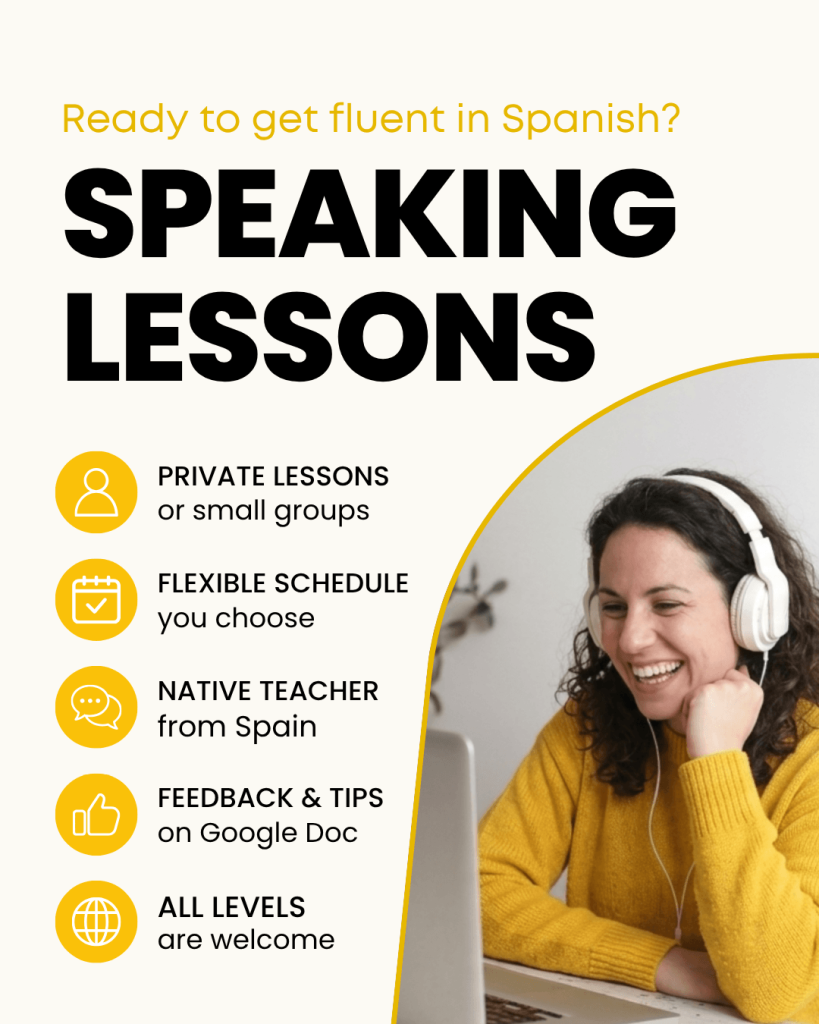
Are you struggling to speak Spanish for real? Would you like to practise in a relaxed environment with a native teacher?
In my private Spanish lessons, you can practise Spanish tailored to your goals, level, and interests, so it becomes easier to learn the language.
Book your FREE trial lesson today and let’s practise Spanish together!