In this post we will talk about one of my favorite ways to practice and learn: language exchanges.
Nowadays there are many alternatives to learn a foreign language, especially the vocabulary, grammar…
However, sometimes it is a bit complicated to practice conversation if we do not live in a country where the language we are studying is spoken.
That’s why language exchanges are a very interesting and affordable option to improve your language skills.
Keep reading because you will surely love this way of practicing.
What is a language exchange?
A language exchange consists of finding someone who is a native speaker of the language you are learning and that person is learning your native language.
In short, the goal is to exchange your native languages to help each other.
Usually the exchange is divided into two parts: first you speak in one language and then in the other. In this way, you both can practice and learn.
Reasons to participate in a language exchange
As you can imagine, there are many benefits of a language exchange in learning a foreign language.
You can practice from anywhere and at any time
It doesn’t matter if you live in a big city or a small town, or if where you live there are no native speakers of the language you are learning.
There are online language exchanges through apps and websites where you can practice with other people wherever you are.
Not to mention that you don’t need to go anywhere: you can do it from the comfort of your own home.
Another plus point is the flexibility of schedule, since no matter when you have free time to practice, I am sure there is someone available to talk to at that time.
You practice real-life conversations in a safe environment
Lo sé, la idea de hablar con un hablante nativo puede ser aterradora, especialmente si aún eres principiante.
But keep in mind that the people who go on these exchanges are also language learners themselves, and they fully understand the challenges and difficulties of learning a new language.
Another plus point is that these language exchanges are a fantastic opportunity to have small conversations before tackling more important ones.
For example, imagine you have a Spanish exam coming up. Practicing with someone at these events will help you strengthen your knowledge and be more prepared for the moment of truth.
In short, they can help you overcome the fear of speaking and become more confident in higher pressure situations.
You learn with native speakers
Practicing with other students is fantastic and much better than not practicing at all. In fact, I have practiced my English with non-native speakers many times and still learned a lot with them.
However, I think there is nothing like conversing with a native speaker. This way, you get used to the accent and intonation.
It’s also great for learning to communicate with the words and expressions that native speakers use in their daily lives (and which are usually different from how we would do it by simply translating literally from one language to another).

You meet new people with a different cultural point of view
Although the main objective of a language exchange is to improve our skills in a foreign language, there are other benefits to be gained.
The truth is that these meetings are also an excellent opportunity to meet new people from many different countries.
In this way, you can make new friends and learn more about their home countries and culture and gain a new perspective and way of seeing the world. In addition, it is an excellent topic of conversation.
Where to find a language exchange partner
I know, this all sounds great but you might be wondering where you can find someone to exchange languages with in this way. Especially if where you live there are not many speakers of the language you are learning.
Fortunately, nowadays there are many options to practice almost any language thanks to the internet.
Language exchange websites
Let’s take a look at some of the most popular websites for finding learning partners:
mylanguageechange.com
Despite its old style, this website is a classic in the world of language exchanges.
The data speak for themself: this community is made up of more than 3 million members from over 175 countries, practicing 164 languages.
Once you register, you can apply filters according to your learning objectives and find a partner to practice with.
Open Language Exchange
Another very popular website. Its operation is similar to the previous one but I personally like the aesthetics much more.
You can also filter by language, city and type of exchange and you will see a list of people and their profile information, such as name, age, location, languages spoken and learned, a description and when they last logged on.

This way you can find people who match your interests and send them a message to see if they are interested in exchanging languages with you.
Language exchange partners on Italki
Italki is known for its lessons with teachers and tutors, but it also has a section where people look for language partners.
If you also want to give it a try, it’s as simple as going to the “community” section and choosing “#languagepartner”. There you will see a list of people interested in a language exchange.
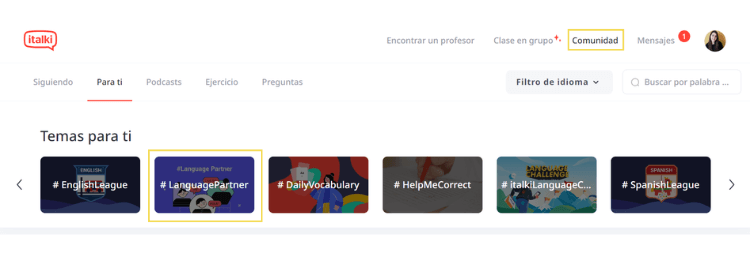
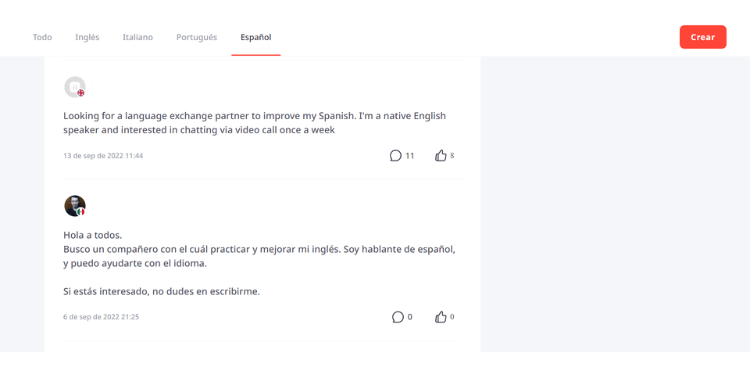
And if you don’t find anyone, try making a post yourself so that other students can see it and write to you to practice.
Language exchange applications
Another very convenient and useful way to find a partner to learn with is through the many language exchange apps.
Below I will tell you about the two I like the most, although the truth is that there are many more.
HelloTalk
This is one of the most popular apps. It is available for both Android and iOS and has more than 30 million users worldwide to chat with and supports more than 150 languages.
To get started you simply sign up and create your profile. HelloTalk connects you with native speakers to chat with for free, based on characteristics and interests similar to yours.
In this app you can practice by messages, audios, voice and video calls and even drawings. But that’s not all. The interface is full of innovative tools to make practicing a language easy and fun.
For example, it includes specific linguistic functions related to translation, pronunciation and corrections, to get the most out of the conversation. It also lets you save your favorite messages.
Best of all, it’s a free application. There is also a premium version, but the free one is enough for most learners.
Tandem
Another one of the most famous language exchange apps. Personally, I like it the most and I have been using it for several years with very good results.
It works in a similar way to HelloTalk: you download the app and create and fill in your profile. Once inside, Tandem shows you potential language partners to practice with.
You can also apply filters to better adjust your search according to your preferences.
When you find someone who meets your learning needs, simply send them a message and start practicing.
In this application you can also send text and audio messages and make voice and video calls. And just like HelloTalk, it also has specific tools for correcting and translating messages.
And now, what in my opinion is the best thing about Tandem. They recently added what they call “parties”. These are rooms where you can enter and talk to other people in real time, as if it were a group call.
There are always several such rooms for practicing Spanish, but if you don’t find one you like, you can create your own to talk about whatever you want and other students can join the conversation.
A fantastic idea to practice, don’t you think?
Online language exchange meetings
So far we have seen apps and websites where you can find partners to practice languages.
However, sometimes it’s a bit complicated to find someone who takes it seriously and with whom you can practice regularly.
But don’t worry, because we have the solution to this problem: language exchange events.
Definitely an easier way to practice languages with other people on a regular basis and with less effort.
Let’s start with some online options.
Online language exchange
I first heard about this language exchange when I went to study English in Ireland, as it used to be done in person in a bar in Dublin and also in other cities in the country.
However, and as a result of the Covid pandemic, its organizers started to do it online and it is a great success.
It is currently held on Mondays and Sundays and you can practice a wide variety of languages, as there are participants from all over the world.
How does it work? Well, you simply have to register on their website and indicate which is your native language and which languages you are learning.
Once you have registered, you receive a Zoom link to connect to in order to participate. When the exchange begins, the organizers divide all the participants into small groups with languages in common.
For example, English speakers who are studying Spanish with Spanish speakers who want to practice English.
This way, everyone can practice both languages for a few minutes before switching.
How much does this language exchange cost? The first time is free (for you to try it out) and afterwards you can participate in exchange for a donation that helps them to continue organizing it.
Undoubtedly a very fun way to meet people from other countries and practice languages without leaving your home.
On their website and social media profiles you can find all the information about dates, times and details of the event.
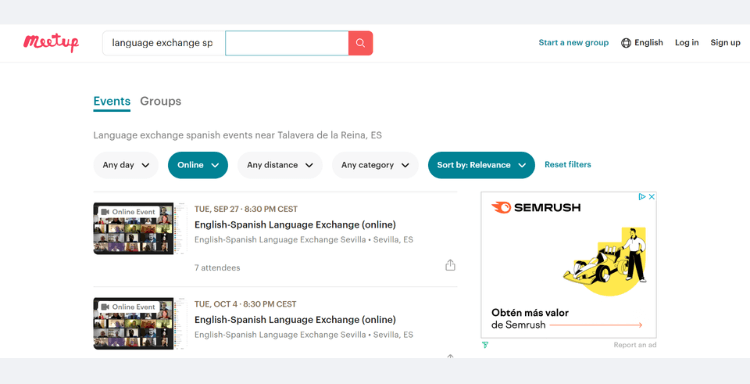
Online Meetup meetings
A similar alternative are the online meetings that are organized in an app called MeetUp (we will talk about this application later).
Although their strong point is face-to-face events, it is true that with the pandemic people also started to organize online events that are still very popular today.
Luckily for you, many of these events include language exchanges. So, I encourage you to take a look at the app and try some of them.
Face-to-face language exchanges
If you are one of those people who prefer to practice languages face-to-face, here are some ideas to help you find such events in your city.
Meetup
Meetup is a very popular application where you can find different plans in the city of your choice.
The best thing is that language exchanges is one of their most popular event categories.
Finding them is super easy. You simply have to search by city and language, or just type in “language exchange” and the city you are in.
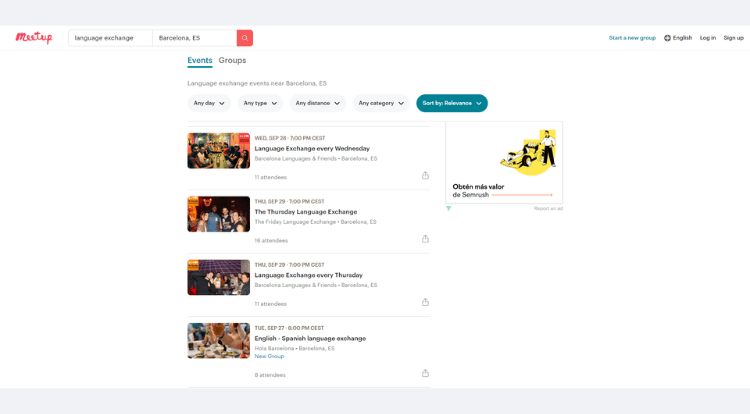
These meetings are usually free or very cheap, and usually take place in a bar, a café or a park.
The truth is that it’s great for practicing languages and meeting new people who live in the same city as you. Very useful if you have just moved, right?
The bad thing is that most of these events are in big cities, so if you live in a small town, you may not have many options.
Although remember that you always have the option of participating in an online language exchange like the ones proposed above.
Facebook groups
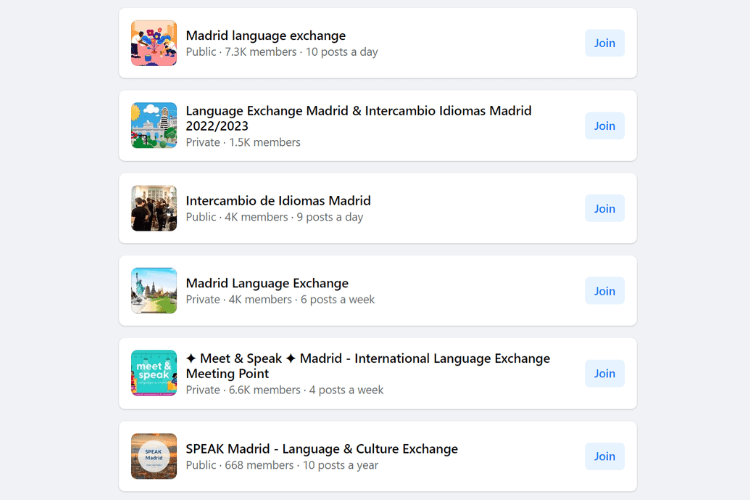
This social network is also an excellent option to find language exchanges in your city.
Simply search for this type of groups as you would search for any other.
The keywords that are usually used in this type of groups are “language exchange”, “language tandem” or “babel” (and its variants in other languages). Of course, don’t forget to add the city you are looking for.
Here is an example of some of the groups that exist in Madrid:
Bars
Some bars and cafes also organize this kind of meetings in their facilities, especially in those cities with more international locations.
And participating is as simple as buying a drink in the bar and start talking to other participants.
Without a doubt, this is a very affordable option for language practice.
Universities and language schools
It is also common for some universities and language schools to organize or promote this type of exchange among their students, especially if there are many international students.
Participating in an exchange to practice Spanish
The good thing about learning Spanish is that since it is a language with a large community and a large number of speakers, it is relatively easy to find native speakers to practice with.
In fact, along with English, Spanish is usually one of the most requested languages in these exchanges.
And if English is your native language or you speak it fluently, so much the better, as it is the foreign language that Spanish speakers are most interested in practicing (at least here in Spain).
Minimum level to participate in a language exchange
This is subjective because it really depends a lot on the person and the language you are going to practice.
In general terms, I think you need to have a minimum level of knowledge to be able to make the most of a language exchange.
For me, this would mean:
- You know the basics of the language in terms of vocabulary and pronunciation.
- You are able to hold at least a simple conversation. It doesn’t matter if your sentences are not 100% correct.
- You understand most of what is being said. It is not necessary to understand 100%; identifying sounds and words and understanding part of the context is enough.
However, this doesn’t mean that as a beginner you can’t participate in them.
Keep reading to find out how.
Tips for doing a language exchange if you are a beginner
Don’t worry if you don’t have such a high level yet. I personally think that beginners can also benefit from language exchanges and speaking as soon as possible is a great way to learn.
Here are some ideas on how to participate:
- You can read aloud to practice pronunciation and comprehension. Try to guess the meaning of words (you can even take notes) and ask your partner to correct your pronunciation. This is very helpful, especially in the beginning, because you can improve your pronunciation and learn new vocabulary.
- If it is a group language exchange, simply listen to the other speakers carefully. Pay attention to their pronunciation, the words they use and try to understand the meaning of the sentences.
- Talk about basic topics with which you are already familiar. If you already know the vocabulary, it will be much easier for you to converse with other people.
- You can define a topic of conversation in advance and learn the related vocabulary before the exchange. This way you will learn the words you need to talk about it and you will feel more prepared.
Alternatives to language exchanges
There is no doubt that participating in these exchanges is a great way to improve your language skills and improve your fluency.
However, it is true that it requires time and effort because you need to find someone to practice with and dedicate part of that time to speaking in your native language so that person also practices.
So, if you are someone who doesn’t have a lot of time or you simply want to study in a more productive way, I recommend finding a private teacher or tutor.
Platforms like Italki or Preply are very useful in this regard, because thanks to them it is very easy to practice a language in a completely personalized way, choosing the teacher, the schedule and even the content.
This was all about language exchanges. I hope you found it interesting and that you will give it a try.
If you have already exchanged languages, you can share your experience in the comments of this article.
And you, would you participate in a language exchange or would you prefer to talk to a teacher or tutor?