Have you studied Spanish for months but still feel nervous when you need to speak? You may know many words, understand grammar explanations, and even watch Spanish videos, but when a real conversation begins, your mind suddenly goes blank.
This is something I hear from students very often. They are putting in effort, but they are not always using the methods that help them improve faster.
To learn Spanish quickly, you do not need to memorize endless vocabulary lists or spend hours studying grammar every day. You need a combination of useful practice, regular exposure to the language, and activities that help you communicate naturally.
In this guide, we will explore practical ways to learn Spanish fast and build the confidence you need to use Spanish in real situations.
Tabla de contenidos
What does it really mean to learn Spanish quickly?
One of the first questions students ask me is: “How long does it take to learn Spanish?” It is a completely understandable question. Everyone wants to know how fast they can reach a level where they can communicate comfortably.
The answer depends on many factors. Your previous experience with languages, the time you dedicate, your learning methods, and how often you use Spanish all influence your progress.
Learning Spanish quickly does not mean rushing through the language. It means avoiding the habits that slow you down and focusing your energy on what really works.
How to learn Spanish fast by using Spanish from day one
Many students believe they need to understand all the grammar before they start speaking. This is one of the biggest obstacles I see in my classes.
A language is a communication tool. The sooner you start using it, the sooner your brain begins to recognize patterns and create connections.
My advice? Start with simple sentences that you can actually use. For example, instead of only memorizing the verb “comer” (to eat), practice complete ideas:
- I eat breakfast every morning. (“Desayuno todas las mañanas.”)
- I want to eat at a restaurant. (“Quiero comer en un restaurante.”)
- I like to eat Spanish food. (“Me gusta comer comida española.”)
The goal is not to create perfect sentences immediately, but to train your brain to communicate.
One thing I often tell my students is that a simple sentence you use 20 times is much more valuable than a complicated sentence you only understand once.
The best way to learn Spanish fast: build daily habits
Many learners expect to find one special technique that changes everything. The reality is that progress comes from combining small habits that you repeat regularly.
You do not need to study Spanish for several hours every day. A focused 20 or 30 minutes can be very effective if you use that time well.
Some habits that will help you make progress include:
- Listening to Spanish every day. Your brain needs regular contact with the sounds, rhythm, and pronunciation of the language.
- Reviewing vocabulary in context. Learning “casa” (house) is useful, but a sentence like “I am going home” (“Voy a casa”) helps you remember how the word works.
- Speaking out loud. Even when you study alone, producing sounds helps you become more comfortable speaking.
- Thinking in Spanish. Try simple thoughts during your day, such as “I am tired” (“Estoy cansado”) or “I need coffee” (“Necesito café.”)
The easiest way to learn Spanish fast is to make the language part of your daily routine instead of treating it as a separate activity.
Different ways to learn Spanish fast that actually work
There is no single learning method that works for everyone. Some students enjoy grammar explanations, while others learn better through conversations, listening, and examples.
When students ask us about different ways to learn Spanish fast, we usually recommend combining several approaches.
Use comprehensible input
One concept that has become very popular among language learners is comprehensive input. It is based on the idea that we improve when we receive a lot of Spanish that we can mostly understand, even if we do not know every single word.
In other words, if you listen to Spanish regularly and understand the general meaning, you start noticing grammar structures, vocabulary, and expressions without having to memorize every rule.
For example, imagine you repeatedly hear:
- I am going to work. (“Voy al trabajo.”)
- I am going to the supermarket. (“Voy al supermercado.”)
- I am going to Spain next year. (“Voy a España el año que viene.”)
Over time, your brain begins to recognize the pattern “voy a” (I am going to) naturally.
Comprehensive input can include podcasts, videos, conversations, graded readers, and other Spanish resources adapted to your level.
The key is choosing material that challenges you but does not make you feel completely lost.
Learn vocabulary that connects with your life
A common mistake is trying to learn thousands of random words. Instead, focus on vocabulary you can use immediately.
If you love cooking, learn words related to food. If you travel often, focus on transportation, hotels, and everyday conversations.
For example, the verb “necesitar” (to need) is extremely useful:
- I need help. (“Necesito ayuda.”)
- I need more time. (“Necesito más tiempo.”)
- I need to practice Spanish. (“Necesito practicar español.”)
Useful words become powerful when you can use them in different situations.
Practice conversations regularly
Do you understand Spanish but cannot speak it? No worries, you are not the only one! This happens because speaking is a separate skill that requires practice.
You can know many words and still feel uncomfortable having a conversation.
That is why you need to get out of your comfort zone and try to practice speaking as much as you can. You can join language exchanges, book a conversational Spanish classes with me, or, if you have the chance, book a trip to a Spanish-speaking country.
Try shadowing to improve pronunciation and fluency
Another technique that many students find helpful is shadowing. Shadowing means listening to a native speaker and repeating what they say while trying to copy their pronunciation, rhythm, and intonation.
This technique is especially useful because Spanish is not only about knowing words. It is also about sounding natural when you put those words together.
If you want to know more, check out this article about shadowing and how to use this technique to improve your speaking skills.
How to speak Spanish fast without feeling overwhelmed
Speaking is often the most stressful part of learning. The first step is accepting that mistakes are part of the process.
You will forget words. You will use the wrong verb ending sometimes. You may translate expressions directly from your native language. This happens to every learner.
Spanish has its own logic, but the more you listen and speak, the more natural these structures become.
To improve your speaking skills, you can:
- Learn complete phrases instead of isolated words.
- Repeat expressions you hear from native speakers.
- Practise conversations about topics you already know.
- Focus on communicating your idea, not creating a perfect sentence.
Remember: confidence comes from using the language.
How to study Spanish fast and remember more
Something I have noticed as a teacher and language learner myself is that some students tend to spend too much time collecting information and not enough time using it.
But learning requires active practice, si instead of only reading vocabulary lists, try creating your own examples.
For instance, if you learn “viaje” (trip), create connections:
- My trip was amazing. (“Mi viaje fue increíble.”)
- I want to travel to Spain. (“Quiero viajar a España.”)
- I am planning a trip. (“Estoy planeando un viaje.”)
These connections make vocabulary easier to remember because your brain understands how words are used.
Focus on consistency: the key to speak Spanish fast
Many students want to know how to learn fluent Spanish fast, but fluency is not created overnight. It comes from repeated exposure and practice.
Based on my experience, the students who improve the most are usually not the ones who study the longest hours. They are the ones who create a routine and continue even when progress feels slow.
Fast Spanish learning is not about doing everything quickly. It is about doing the right things often.
Listen regularly. Speak regularly. Review regularly. These simple actions create long-term results.
Mistakes that slow down your Spanish progress
You might work very hard but still feel stuck because you focus on activities that do not give you enough practice.
Here are some common problems I see all the time:
- Waiting until your Spanish is perfect. You improve by using Spanish, not by waiting.
- Only studying grammar. Grammar is important, but it needs communication to become useful.
- Learning too many words without using them. Active vocabulary is much more valuable.
- Avoiding conversations. Speaking improves through speaking.
Remember: every mistake is information and every conversation is practice.
Final thoughts on fast Spanish learning
If you want to learn Spanish fast, focus on building a relationship with the language. Listen to it, use it, and make it part of your daily life.
Spanish is not only a collection of grammar rules. It is a way to connect with people, discover cultures, and express yourself in a new way.
With the right habits, useful strategies like comprehensive input and shadowing, and regular speaking practice, you can make real progress and enjoy the journey.
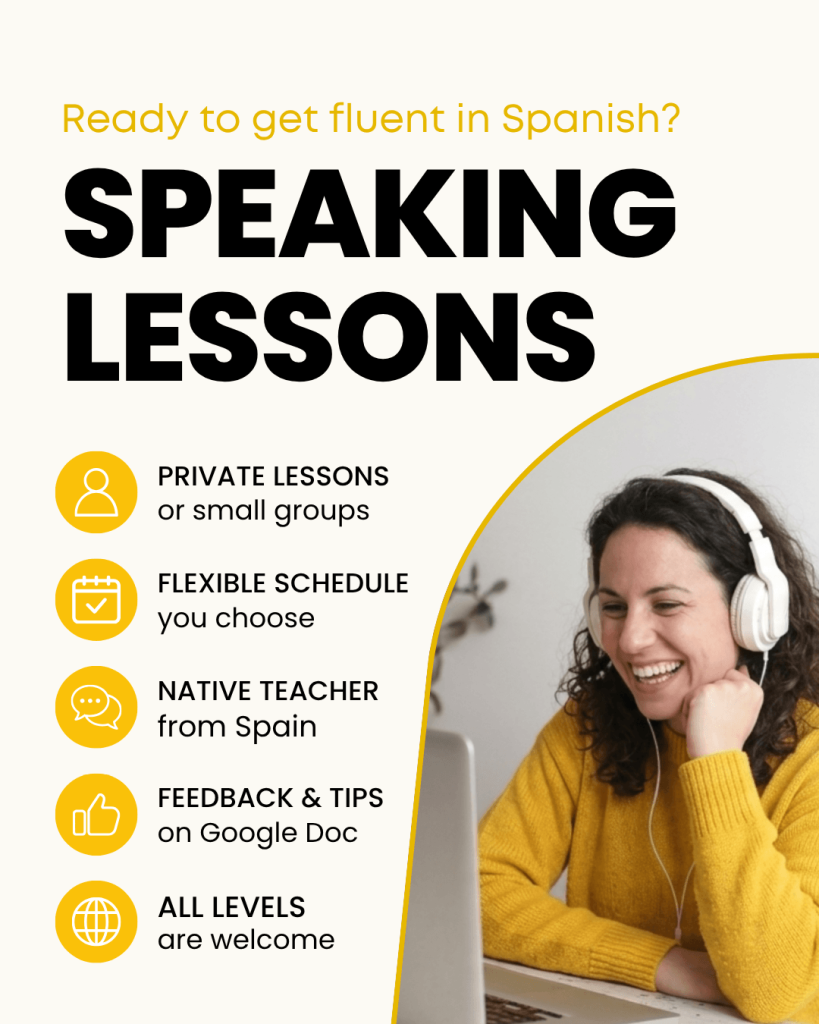
And last but not least, if you want to learn Spanish faster, I offer private Spanish lessons, fully tailored to your goals, level, and interests. This way you’ll improve the aspects you really need.
Book your FREE trial lesson today and let’s practice Spanish together!